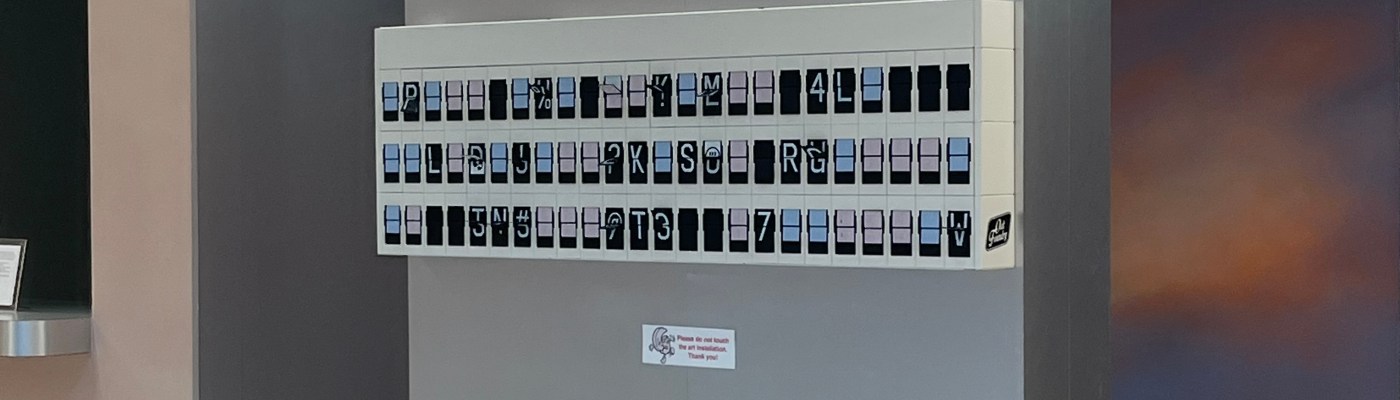
Earlier this year, Glossier revealed plans to close nine of its twelve standalone stores, leaving its outposts in Manhattan, LA, and London. So when I moved to Washington, D.C. last month, I decided I’d better hit up the airport-themed Georgetown location and write a post about it before it vanished. I made a hurried trip to Georgetown, found no sign of imminent closure (the place was bustling with teenage girls on a Thursday afternoon), did some more research when I got home, and realized that I’d missed a crucial detail: Glossier will be closing those nine stores over the next two and a half years. Given the level of confusion I’ve seen online, I can’t have been the only one to overlook that detail. If I were a Glossier conspiracy theorist, I’d say Glossier was hoping that careless readers would miss the “two and a half years” bit and hasten to the nearest store. But I’m not a Glossier conspiracy theorist—not all the time, at least—and I suspect the vague timeline is another example of Glossier’s usual haphazard approach to logistics. (On July 13, they announced the closing of their Chicago store…which is happening today, the 19th.)
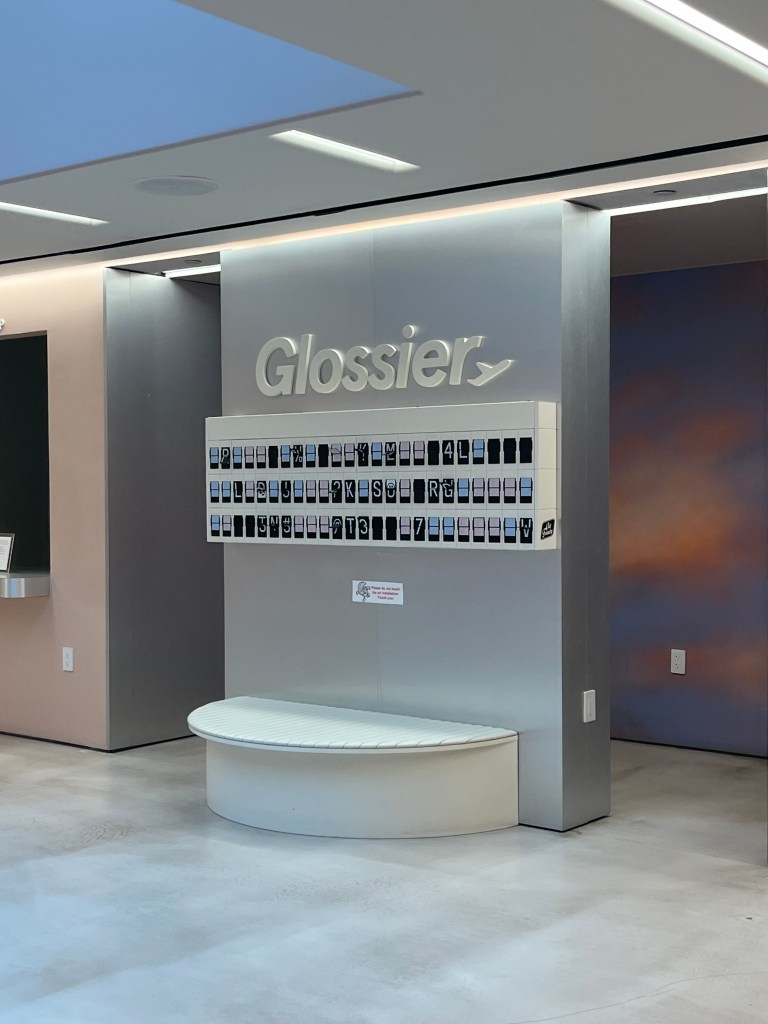
Since my first trip to Glossier D.C. was cut short by an approaching thunderstorm (I’d forgotten my umbrella and needed to catch a bus back to my neighborhood before the skies opened), I plan to visit a second time before writing about it. In the meantime, though, I’ll use this post to reflect on where Glossier is now, a dozen years after its founding, and a few months after its third CEO laid off dozens of employees and announced the store closures. I wrote my last such post almost exactly four years ago, as Glossier’s second CEO took over from Emily Weiss and began an ambitious brand expansion that proved roughly as successful in reviving Glossier’s golden age as Brat Summer did in saving democracy.
First, for the sake of my own mental clarity as much as yours, I’ve put together a chronology of Glossier’s twelve-year history.* It’s not exhaustive by any means, but I’ve included the events, product launches, layoffs, and lipstick reformulations that strike me as especially important. If I got any of the dates wrong, please let me know!
September 2010: Emily Weiss, a wealthy and well-connected 25-year-old styling assistant at Vogue, starts a blog called Into the Gloss, where she interviews her socialite friends about their beauty routines. The bathroom cabinets of trust-fund “stylists” and “DJs” are entertaining enough, but the real energy circulates in the comments, where loyal readers swap skincare tips and product recommendations—and where, eventually, Weiss crowdsources ideas for a new beauty brand.
October 2014: Backed by venture capitalists in Silicon Valley, Glossier hits the market with four products (clear Balm Dotcom, Priming Moisturizer, Skin Tint, and Soothing Face Mist), plus, of course, the iconic pink bubble bag.
November 2014: Weiss tries to convince Into the Gloss readers that the perfect holiday party look consists of nothing but Skin Tint, Balm Dotcom, black mascara, and two Piaget necklaces. Then, a surprise reversal: the appearance of Glossier’s first color makeup, two limited-edition liquid foil eyeliners in silver and gold. I remember reading about those eyeliners on the subterranean C Floor of Princeton’s Firestone Library when I should have been working on my dissertation. Good times. (This Reddit post has a useful chronology of Glossier’s holiday launches from 2014 to 2020.)
March 2016: Glossier debuts Phase 2: Boy Brow, Stretch Concealer, and the first version of Generation G lipstick.
October 2016: Glossier reformulates Generation G, promising a “more gliding and sleek” formula that also lasts longer.
November 2016: The four-piece Black Tie holiday set includes a pink nail polish that never returns. To this day, some wonder whether the polish ever really existed except in a collective millennial fever dream induced by the trauma of Trump’s first election.
December 2016: Glossier opens its first store, a temporary showroom in Manhattan (not all that temporary: I visited in June of 2018).
Spring 2017: Through its Glossier Rep program, the brand invites bloggers and other influencers to review new Glossier products, sometimes before they become available to the general public. Each rep has their own page on Glossier’s website through which their readers can place orders at a discount. The program resembles the multilevel marketing schemes popular on social media at the time, except that Glossier reps don’t recruit other reps—the exclusivity, or appearance thereof, is the point. (I can’t figure out when the rep program ended; around 2020, maybe? Anyone know for sure?)
October 2017: Glossier introduces its first perfume: Glossier You, “the ultimate personal fragrance.” The launch involves a pop-up “experience space” in NYC in which the customer is led into a Twin Peaks-esque red room and spritzed with You by a disembodied hand.
May 2018: Glossier launches its subtly lengthening “film form” mascara, Lash Slick, for $16. (As of July 2026, it’s $20. Feel old yet?)
November 2018: Glossier opens its first permanent store in Manhattan. Ironically, this iteration of the store will be shorter-lived than the original showroom.
November 2018: The third formulation of Generation G debuts with “a smoother, softer, more cushion-y texture,” “a truer matte finish,” “stronger, more luxurious packaging,” and a rose-lychee fragrance. (I reviewed Gen G 3.0 here. It sucked.)
March 2019: Glossier launches a sub-brand, Glossier Play, which many now see as the beginning of the end of peak Glossier. Comprising face glitter, liquid highlighter, shiny lip colors, and brightly colored eyeliners, the disco-inspired Play is a sharp departure from Glossier’s “skincare first, makeup second” ethos—and it flops. Hard. Customers hate its wasteful plastic packaging (fair) and its apparent incongruence with Glossier’s original identity (everyone forgot about the metallic eyeliners in 2014 and the recurring Top Shelf After Dark feature on Into the Gloss, I guess?). Fast Company describes Play as “the first of many brands Glossier intends to spin out,” but that intention, needless to say, goes nowhere.
February 2020: Glossier discontinues Play, setting in motion the narrative that Play was “Glossier’s finest hour” and could have prevented the brand’s post-COVID slump. For the next six years, the denizens of r/glossier—the same people who reviled Play because it was “designed by an older man”—will insist that axing the sub-brand was the worst mistake Glossier ever made. And so Glossier learns what the rest of us already knew: trying to keep Redditors happy is a fruitless endeavor.
March 2020: As the COVID pandemic spreads, Glossier shuts down its three stores in NYC and LA.
August 2020: Glossier lays off all of its retail workers (“offline editors”) and announces that its stores will remain closed through the end of 2020. A few days later, Outta the Gloss, a collective of former offline editors, publishes an open letter accusing Glossier of mistreating workers, particularly employees of color, at its NYC flagship store.
2021-2022: Emboldened by the COVID vaccine, Glossier opens new stores across the U.S., plus one in London.
January 2022: Glossier lays off 80 employees in response to declining sales in 2021.
April 2022: Olivia Rodrigo becomes Glossier’s first celebrity partner (well, first official celebrity partner—Glossier has been sending products to celebrities and their makeup artists since its inception).
May 2022: Weiss steps down from her CEO position, prompting dire headlines like “The Sunsetting of the Girlboss Is Nearly Complete.” Weiss is replaced by Kyle Leahy (a woman, btw), who previously worked for Cole Haan and General Motors but has no background in the beauty industry.
February 2023: Glossier moves into Sephora and reopens its flagship store on Spring Street in Soho.
December 2023: The fourth version of Generation G makes its quiet debut (I can’t find an official announcement anywhere). This reformulation removes the rose-lychee fragrance and, to the best of my knowledge, is the version still on shelves at the time of writing.
May 2025: Glossier collaborates with the kpop-adjacent girl group Katseye on the release of Lip Glaze, a plumping lip oil. Gnarly!
June 2025: Just three years after assuming the CEO position, Kyle Leahy announces that she will leave Glossier.
September 2025: Colin Walsh, formerly of Ouai, takes over as Glossier’s third CEO.
April 2026: Glossier announces that it will close nine of its twelve stores in the next two and a half years.
June 2026: Generation G is discounted on Glossier’s website, leading to speculation about an upcoming fourth reformulation, this one to remove an ingredient banned in the EU. Will Gen G 5.0 succeed where the others failed? Only time will tell!
July 2026: Glossier teams up with the New York State Tourism Board for an “I Love NY”-themed launch, featuring an apple-flavored Balm Dotcom (sold at bodegas throughout the city) and a six-week-long “Balmdega” pop-up at the Soho store. Rama Duwaji partnership when?
Compiling this timeline led me to three conclusions:
1. Live by the crowdsource, die by the crowdsource. During its planning stages, Glossier had access to an invaluable resource: years of completely free feedback from its potential customer base. Even after the brand launched, commenters on ITG eagerly offered suggestions for product development, and Glossier’s writers responded to the comments and took many of the suggestions. Then, for some reason, Glossier began moving away from the crowdsourced model. It put less and less effort into ITG, deleted critical comments, and eventually shut down the blog’s comment section entirely. It also discontinued the rep program and the affiliate links that every customer, rep or not, received. I suppose the brand no longer wanted to be beholden to a small group of opinionated fans. But Glossier had spent years fostering a parasocial relationship with those fans, and now, understandably, they felt betrayed. If you use your customers as unpaid focus groups and product testers, they’ll expect you to actually listen to their suggestions—and when you don’t, they’ll turn against you. Surprise!
Glossier Play was the turning point, I think—the first time that Glossier’s original fanbase felt that it hadn’t been consulted about a big launch. To its credit, Glossier listened to the complaints about the plastic packaging and non-biodegradable glitter. But the damage had been done, because the real objection to Glossier Play was aesthetic, not environmental. Which brings me to my second point:
2. Becoming the face of a generation isn’t always wise. Most of ITG’s faithful commenters were millennial women; so were most of Glossier’s original visionaries and employees, including Weiss herself. Glossier quickly became the millennial beauty brand, speaking to us in the wry, irreverent voice of blogs and viral tweets. That voice felt genuine, because it more or less was genuine. And in the 2010s, millennials were the cool young people whom every corporation was trying to court. Why shouldn’t Glossier go all in on courting them, too?
Well, because cool young people age. In 2014, the youngest millennials were starting college. By the end of the decade, though, the oldest millennials were pushing forty, and Gen Z had become the new demographic to chase. And Glossier’s decisions in the 2020s revealed that it was loyal not to millennials, its original customer base, but to young people in general. In other words, it was like every other beauty brand.
I don’t blame Glossier for not wanting to be forever tied to a specific generation; that’s the kiss of death for culture of all kinds. But what happens when those teenagers I saw at the Georgetown store age out of coolness? Will Glossier once again pivot to attract an even younger crowd? Or can it, like a good book or song, transcend generational divides while retaining something of the era that produced it? Time will tell.
3. A brand can coast on vibes for only so long. Even in my earliest experiences with Glossier, I detected a certain sloppiness in its offerings and marketing. Some of the sloppiness was deliberate, to be sure. The brand had grown out of a blog, and the best blogs felt spontaneous and a little amateurish, not polished and professional. The characteristic Glossier look was low-effort and breezy and “French-girl,” an antidote to the labor-intensive drag-inspired makeup popular in the mid-2010s. Because of all this intentional devil-may-careitude, customers were primed to excuse Glossier’s unintentional missteps, too. Maybe the repeated reformulations of Generation G weren’t indications of a lack of planning; maybe they were praiseworthy responses to customer feedback. After all, few beauty brands allowed customers to see, let alone actively influence, how a product was developed and marketed. Glossier’s rough-around-the-edges vibe was part of its charm; delight in disorder and all that.
Once again, Glossier Play was the moment when the cracks began to show. The rollout felt rushed. The website lacked accurate swatches of the new products, and the unclear swatch photos hastily posted to IG Stories only made matters worse. The laissez-faire approach that had seemed so charming in 2014 came off as lazy and disrespectful in 2019. Five years into its existence, Glossier simply hadn’t put in the effort to convince its customers that Play was a logical next step for the brand. It hadn’t bothered to tell a coherent story about all the color and glitter. And instead of responding constructively to the backlash, it gave up on Play after less than a year and deleted every mention of it from ITG. (Seriously, try searching the website for “glossier play” or “vinylic lip” and see what comes up.)
After all that, some final thoughts:
I haven’t bought a Glossier product since 2024. To be fair, I haven’t bought much of anything since 2024, because of my intermittent employment. But when I get my first paycheck from my new teaching job in September, will I be running to Sephora to buy the newest Glossier products? Probably not (though I might pick up a tube of Lash Slick). I’ve actually lost track of what they’ve released, reformulated, and discontinued in the last few years. There are some new powder blushes that have that nightmarish floury texture I hate. There are lip liners, but I’m not going to spend $18 on a fucking lip liner when my $6 NYX Slim Lip Pencils work so well. There are four spinoffs of Glossier You, all of which leave me cold. There are those Katseye-endorsed lip oils, but though I do like Katseye, I hate plumping products. I’d buy a new Cloud Paint, maybe—if my tubes from 2018 weren’t still going strong.
And yet, somehow, I feel cautiously optimistic about Glossier’s future (watch them file bankruptcy a month after I publish this post). They haven’t been acquired by a big conglomerate or, God forbid, by private equity, so they have the freedom to figure out what makes them special and double down on that. If I were advising Glossier—which I guess I am, albeit unofficially—I’d remind them that their initial success lay in making skincare and color makeup feel approachable and user-friendly, yet still fun and aspirational. There will always be a niche in the market for a subtle mascara like Lash Slick or a lightweight liquid blush like Cloud Paint. And those products appeal to all ages, not just to teenagers! There’s nothing wrong with hiring Olivia Rodrigo or Katseye to promote products, but going all in on becoming a “Gen Z brand” instead of a “millennial brand” won’t serve Glossier well when trends shift yet again. I’d also implore them to ditch the low-effort AI-generated email and IG replies and refocus on building meaningful connections with customers. I mean, look at me: I fancy myself some sort of snarky anti-corporate truth-teller, yet I’ve spent an entire decade analyzing Glossier on my blog! This post is 2,700 words long! That’s parasocial gold right there.
I hope to make a second visit to Glossier D.C. in the next week or two, so I’ll be back before too long!
*I discovered halfway through writing this post that a Substacker published her own timeline back in May. That article goes into more detail than mine about the brand’s finances; there’s also a second post discussing the writer’s thoughts on the current state of Glossier. Both are well worth a look!


Highly tangential (I hope that as an academic, you’ll forgive my weird train of thought) but you’ve previously blogged about Barry M polishes on your occasional travels across the pond. As a Brit girl who hasn’t had bare nails since I was 15, BM is an absolute staple and the most represented brand in my polish collection (*possibly* now superseded by ILNP, thanks to their Black Friday sales?? Definitely still far and away the most cremes, though).
They have recently been bought by private equity. Admittedly, a firm that’s apparently bought beauty brands before and managed them reasonably well, and the Barry M stands are still very much present in every Boots and Superdrug I’ve been in (with even a couple of new things occasionally). But still, please pray for us.
LikeLike
Digressions always welcome! But that is sad news. I was wearing one of my Barry M polishes from 2016 just a week or two ago and wishing the brand were available here. I remember they had really interesting colors and finishes for a drugstore brand–similar to Essie but cheaper and more varied. I’m praying for you, and praying that Barry M will still be a decent brand when I finally make it back to the UK!
LikeLike
Yeah, I do a lot of nail art and they make that really affordable (though sadly there haven’t been many of the cool interesting finishes in the past few years – or maybe I’m just jaded by indies). 2016 was such a good era of fun nail polish from even mainstream clothing brands – a great time to be a teenaged magpie newly granted pocket money!
LikeLike